by Mikayla Sambrooks, Senior Exploration Geophysicist at Fleet Space Technologies and Federal Secretary at ASEG
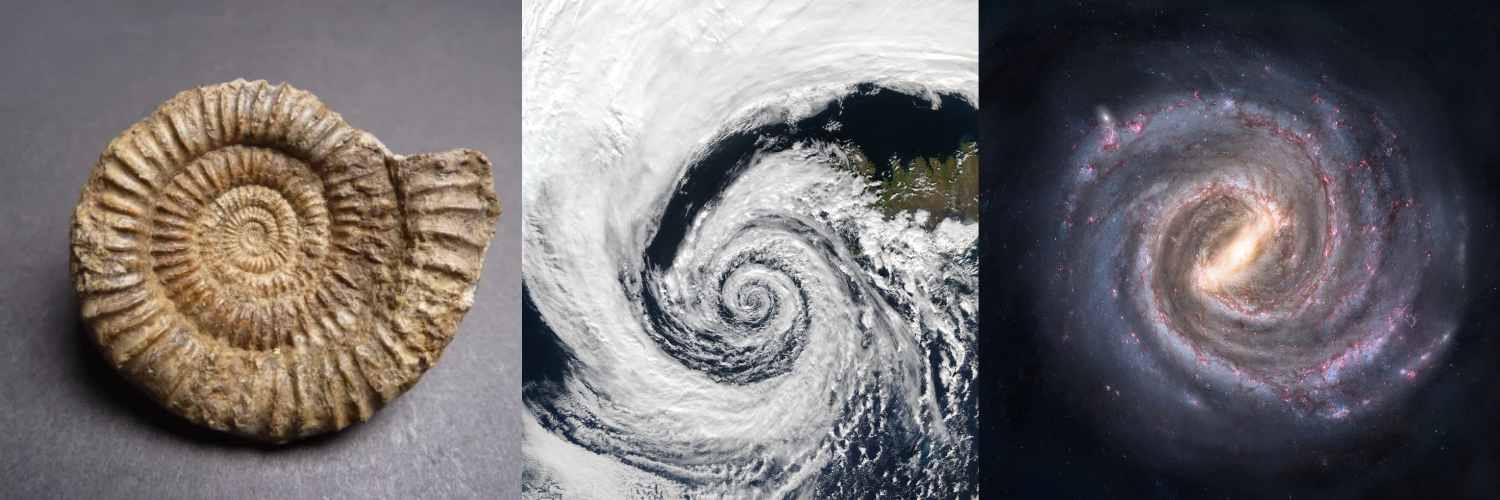
Ammonite shell (by Mahmut MAT, geologyscience.com)
An extratropical cyclone near Iceland (NASA/GSFC, MODIS Rapid Response Team, Jacques Descloitres)
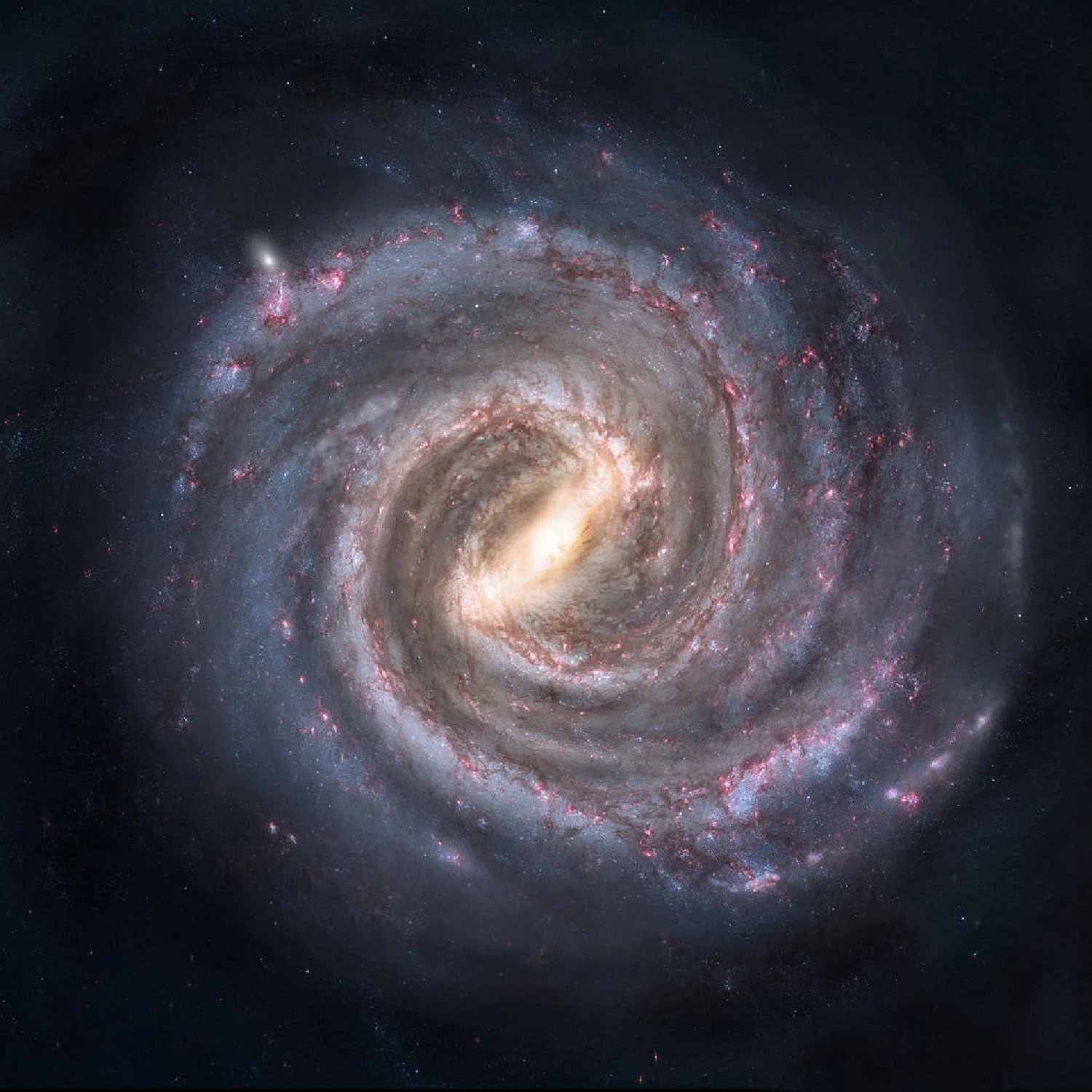
Milky Way (Matthew Williams, November 04, 2013 08:13 AM UTC, universetoday.com)
What is a fractal?
Fractals can be defined as self-similar patterns that repeat over several orders of magnitude in scale. The patterns themselves range from being simplistic and easily recognizable, to infinitely complex and difficult to perceive. If this is the first time you’re reading about fractals, I have no doubt you’ll have seen and interacted with them in your everyday life, even if unknowingly.
For instance, have you ever noticed how ammonite shells, cyclone systems, and our very own galaxy share the same spiral pattern? This is no coincidence. They all follow fractal geometry (the self-repeating pattern at all scales) using numbers from the Fibonacci sequence. The pattern in the sequence is that every number, aside from the first two, is equal to the sum of the two numbers before it in the sequence. This ultimately results in a spiral that gets bigger or smaller by the same ‘golden’ ratio at each turn (Sivakumar et al., 2025).
Much more complex fractal patterns exist that govern processes you know of but may not recognize as following fractal geometry at first. For example, the formation of a rugged coastline, the paths a lightning strike takes, or the growth structure of a neuron, all follow fractal patterns. Complex fractal patterns reveal a sense of order within what appears to be chaos, proving extremely useful for making predictions in non-linear deterministic environments (Kaur et al., 2025), like weather forecasting or stock market trends.
Fractal geometry is even being used to understand the structure of the universe at its most fundamental level. Recently, researchers at MIT discovered that certain quantum materials exhibit a fractal-like pattern in their magnetic domains (Chu, 2019). This discovery could have profound implications for our understanding of quantum phase transitions and the development of new materials for quantum computing.
Fractals in geoscience
But what about geoscience? For a discipline that is centered around understanding dynamic natural systems that transcend scale in time and space, it makes sense that fractals should play a fundamental role in achieving that endeavor. It’s occurred to me more than once that structural patterns seem to reappear at very different scales, like shear fabric observed at the nanometer scale in thin sections, or a fault escarpment that traverses hundreds of kilometers interpreted from remote-sense data and field observations. So, are we really taking advantage of fractals in geoscience as well as other industries? It appears that some are!
Beyond the quantum scale, fractal geometry has played a critical role in how we interpret the vast landscapes of planetary bodies. Research into lunar and Martian crater ejecta demonstrates that many planetary landforms lack a single, measurable perimeter; instead, they exhibit a ‘coastline paradox’ where the measured length increases significantly as the measurement scale becomes finer (Robbins, 2018). This scale-dependency means that traditional geological metrics, such as lobateness, can fluctuate by an order of magnitude depending on the resolution of imagery used. By calculating the fractal dimension of these features, geologists can move beyond subjective visual descriptions and use mathematical complexity as a diagnostic tool to distinguish between surface processes (Robbins, 2018).
In the field of geophysics, these principles could be leveraged to generate more realistic predictions. Since many fundamental geophysical problems are inherently geometric, fractal geometry can be used at the survey planning stage to optimize station spacing for maximum efficiency and data resolution. Furthermore, fractals could be implemented at the inversion stage to influence mesh geometry for better computational performance, or at the interpretation stage to allow for more quantitative and consistent analysis of results.
In the mining and exploration industry specifically, fractal dimension is being used as a proxy to understand the spatial distribution of Carlin-type gold deposits (Wang et al., 2023). By identifying the fractal patterns in the distribution of gold mineralization, geologists can more effectively target potential deposits and optimize their drilling programs.
It seems to me that the possibilities for improving processes in geoscience using fractals could be infinite! Where do you see the potential for uplift across the exploration and drilling industries using fractals?
References
Chu, J. (2019, October 16). Scientists discover fractal patterns in quantum material. MIT News Office. Available at: news.mit.edu/2019/fractal-patterns-quantum-material-1016.
Kaur, S., Kumar, R., & Singh, J. (2025). Escape criterion using fixed point iteration with applications in fractal generation. International Journal of Mathematical, Engineering and Management Sciences, 10(6), 1701–1720.
Robbins, S. J. (2018). The fractal nature of planetary landforms and implications to geologic mapping. Earth and Space Science, 5(11), 711–720.
Sivakumar, S., Rathinasamy, A., & Balakrishnan, K. (2025). On the evolution and importance of the Fibonacci sequence in visualization of fractals. Chaos, Solitons & Fractals, 191, 115851.
Wang, G., Zhang, S., & Li, R. (2023). Fractal dimension used as a proxy to understand the spatial distribution for Carlin-type gold deposits. Ore Geology Reviews, 158, 105534.
For more information: Get in touch with Mikayla on LinkedIn